My Future Annulment
The dummy at the table next to me wants to marry “eeeeeearly.” Her whiny, long-wrought “eeeee” almost made me regurgitate this peach muffin I have pined after all morning. Most women have learned the trade of keeping things down in disgust, and today I exercised this talent without any effort or need to please a man.
This brings me back to my First Communion. I took the bread, swallowed the wine, donned an angel face, while the girl sitting next to me rejected it—literally. Stomach bile smeared across her dress and the floor of the chapel. The memory hot-branded onto my psyche, mainly because of the contents of her throw up: perfectly sliced peaches. Twenty years later, I’m eating a peach muffin whilst writing about it—a confirmation of my comfort in disgust. Speaking of Confirmation, I never made it that far. By then, I had other things to spit out.
All in all, I kept down the body and blood of Christ. I swished the wine between my cheeks and de-wrinkled my dry white dress with my puke-free hands. In all my piety, I was superior to the hurl-girl.
In her defense, I had practice. I went to Christian school up until my expulsion in sixth grade. I acquired the cheat code to immaculation. I knew how to stay unnoticed during indoctrination. I knew how to worship the man, receive his body when asked, give no flack and all the while, “appear” to enjoy it.
Perhaps my idea of what constitutes disgust is different from most women’s. Perhaps I do understand this girl’s matrimonial desire. Perhaps it was once a desire of my own, which makes sense, considering I was a novice to the romance scene in my late teens. While most girls were at their school swim meet or prom, I was in the med line at the detox center. That, and a sex-drive and opiate addiction seldom coexist.
I’m a late bloomer, one could say. Physically, my bosoms budded at 18; emotionally, some days I am 80 years old and absolutely indifferent, other days, 11 years old, tantrum-y and without regulation.
I’d rather discuss the junk I now refuse to swallow, though. Like the idea of marriage as consolation. Or the idea that Jewish girls do, in fact, suck dick. Or the fact that God is a dog, and Jesus Christ: a tall, dark, handsome man-whore.
So yeah, marriage is no consolation, and interjecting on this twenty-one-year-old’s fever dream at the bakery is just as as futile of an endeavor.
“I want companionship!” she let out in another very irking shriek.
She’s sitting across from a friend, which feels ironic considering her companionship complaint, but once again, useless to bring to her attention. Her friend listens attentively, while sucking out the poppy seeds wedged between her braces.
I see what happens to the ladies on Real Housewives. Anytime they open their traps, it’s a bitch-fest about the pangs of being “The Divorcee”. It’s their go-to talking point over cosmos and caviar at Bagatelle, despite the six-figure alimony paying the tab.
I wipe the oil from the peach muffin on my pants to finish this anti-marriage manifesto.
The dummy girl in hot pursuit for marriage is possibly not dumb, sure, but she is certainly a sheep, like all the others who believe marriage is a resolve or salve. Osho said it best:
“Love, but don’t let your love degrade into marriage.”
“I’m not saying don’t get married. It is a formality. Good, satisfy society”, because these NPCs keep the wheel of social mores a’ turning, and that’s always been the case. So no, I’m not mad. In fact, I’m laughing at the trite of life.
All in all, my future ex-husband hates me; but the undeniable fact is: others like me, I mean, they really like me. Dogs want my scritches, strangers tell me their stories, and I’m every kid’s favorite teacher.
It’s a funny thing, sitting here with peach soiled pants, annoyed at strangers, faking the fact that I’m above it. I’m actually below it, a nasty girl who finds solace in having no entry into heaven, Jesus’s nickers, or the Catholic church’s marriage register. My future annulment written in the stars<3!
Thanks to Fate, I Finally Picked up Fiction
I’m done learning for now, but mostly, unlearning, as that seems to be more pressing in my life. The art of letting go requires far more unlearning than learning. The art of letting go also requires you to put down the books with adjacent titles to “The Art of Letting Go.” My eyes have followed the scribblings of Alan Watts, I felt safe in the long pauses between Ram Dass’ words, I feared the inapplicability of the jarring Zen Teachings of Huang Po, and alongside warrior Arjuna, I journeyed through the Hindu-holy Krishna-partisan that is the Bhagavad Gita. Through it all, I chilled, surely surrendered, at least a smidge. Nah, you know what, I’ll give myself more credit, considering the depth of my neurosis—“heaps” is a more suitable quantitative measure. All in all, knee deep in Eastern thought, I chilled the fuck out. My mind didn’t go bizzerk, as it once did with the Westerner callous-criticals: The Hegels, The Foucaults, Freudians, Lockes, Humes, Heideggers, The Kants. The words of their world really spun me up, wound me tight, and all their questions and answers only left me with more questions that needed answers. It was a hamster wheel thing, and I’m glad I extricated myself before I became a full-blown spunion.
The day I finished The Gita is the day I picked up fiction, and I have yet to return to Western philosophy, teachings alike, medical journals, studies that promote longevity, and all other systematic academic-type beats. I felt bright that day, walking down a lonesome street. The sun was out, which deluded myself into feeling such brightness. How extraordinary! To be deluded into happiness! My gait was prideful, because The Gita sat on the shelf for half a year before I decided to give it a real shot, a real finish. I realize now that The Gita then would’ve been no match in meaning to having read it now. I wasn’t ready for The Gita then. I now understand the trust one must have in Krishna, especially in terms of timing. So, on this day, the day I finished The Gita, my journey to fate led me to one of those “free libraries” parked on a sidewalk in front of a suburban home—a birdhouse-type exposé, wooden, with a framed plastic door and a brass hook-and-eye latch. There it was: James, black, hard-covered, beautiful, and written by a literary mastermind of our time, Percival Everett.
My discovery of Everett’s mastery started a while back, with his novel Erasure, which was renditioned into a film dubbed American Fiction, to which you could pinpoint better than the novel, I’m sure, considering people don’t read much anymore. I once wrote a paper on Erasure—an angsty delve into the concept of the reader’s authority over an author’s selfhood. Had I the relationship I have with Everett’s work now, reading Erasure would’ve been a far different experience, one of more laughs and less of being a white savior. This paper is a perfect representation of the academic craze I wish to walk away from. Here’s a quote from it: “Confession is the light, and readers, the fly.” That probably adds little context, so here’s a lengthier, non-lyrical one: “I had managed to take myself, the writer, reconfigure myself, then disintegrate myself… (Everett 257).” Such insights imply that the sense of “ownership of the Earth,” as W.E.B. Du Bois identifies with whiteness in the twentieth century, is rooted in the regime of racial capitalism that turns Black persons into commodities. In Erasure, by popular demand, Black authorship is being asked to limit and fragment itself into only producing stereotypical “Black” narratives that masquerade as “Black” “representation” and therefore, “activism”—i.e., TV shows like Love and Hip Hop and Flavor of Love. “Black abolitionary” writing is not something protagonist Monk wishes to feign and deliver though; he is more focused on the ins and outs of post-structuralism and even carpentry. But a writer needs cake, so Monk stakes selfhood in order to qualify his self, who had value without qualification, whether pedagogical or intuitional, whether Black, purple, writer, or just mere liver of life.”
Shit, who am I to continue this word vomit? I admit it. I’m hypocritically performing yet another autopsy on a Black individual’s writing. My point of the reader being the nuisance fly, death-bound and too prideful to leave the writer and his illuminated vision alone. My Icarus’s wings melted in the sun. So yea, it’s for certain: the reader, especially the white reader, not only has authority over the author’s selfhood but is smugly entitled to it. Now you can truly understand the trajectory of catapulting yourself into an academic dimension that is almost always mistaken for “intelligence.”
It’s interesting: before stumbling across Everett’s newest Pulitzer Prize winner James in the free library, I saw it at Barnes and Noble and came very close to buying it. I didn’t though, because my thrifty self decided twenty bucks was just too steep. After reading James, for free, by fate, I never gave a second thought to the dollar amount of Everett’s books. I rushed to buy The Trees, I’m Not Sidney Poitier, and Dr. No the day I knew I’d finish James, which took me about three days—record time for me. While The Gita, Dhammapada, Osho, Watts, Baba, The Yoga Sutras of Patanjali did all that they were set out in the world to do to and for me, I missed the belly laughs, eye-rolls, and sustained smirk fiction like this gave me. While learning and unlearning is good, sure, needed, yes, and sometimes unfathomably and elitistically hailed, laughter is a lesson unmatchable, a Deity in its own right. I say all this because tomorrow, a Saturday, my only plan is to check-out Everett’s Telephone from the local library, curl up into a comfortable corner on my couch, turn some pages, and cackle about.
The Students Really Think I Grade Their Papers with Integrity but I Don’t
I write this from the safety and privacy of another teacher’s desk. I absolutely love that this is not my hole, not my spiel, not my life to give, but damn do I wish it was my paycheck to waste. I am the sub, meaning no one will approach. We don’t have that rapport, and I like not being bothered. We take our peace for granted so often. Being bothered by a student is seldom about an academic question, just a sign of their adoration for you or their inability to emotionally self-regulate —one feeling like a head scratch, the other, box braids on a white girl scalp. Tickled touch, primped pain; nevertheless, the students are always coming forth with qualms that need quelling. Even if the line doesn’t reach, and all the advice I offer is to no avail, they take comfort in my hearing them, and I enjoy challenging their reckless thinking. For example:
“Miss, she’s playing games. During lunch, she act like I don’t even exist, but then wanna be all nice once no one’s around. I swear Ima pay it back. She’S gonna feel what it’s like.”
“Oh yeah? Maybe she’s just nervous, kid. Maybe she feels more comfortable with her friends at lunch, you know her—she’s shy, and sometimes you can be a lot.”
“Man, I don’t care if she’s shy, she be playing games.”
“You comin’ across as angry, but I know you’re really just feeling hurt. You act like you ain’t sensitive. I don’t buy it.”
“I’m not sensitive, Miss.”
“But you are…”
“Whatever, Miss, ima just cut ties, I ain’t with all that. It’s her loss.”
“Nah. It’s yours too. She’s a sweet girl. You know what, let’s write her a letter. Just be upfront with how you feel; she probably doesn’t even realize you’re annoyed.”
“Miss, I’m not writing her no letter.”
“C’mon dude, being vulnerable is whatsup. Why ya’ll all so scared of being vulnerable?”
“Miss, I’m not scared of being vulnerable, I’m just not going to write some letter.”
“Whatever. Ya’ll cute, and she’d probably like a lil note. Don’t you like her?”
“I’m starting not to.”
“Don’t say that.”
“I mean it.”
“Whatever. Where you supposed to be anyways?”
“Spanish, but I hate Ms. ***, she be doing too much.”
“I love Ms. ***, she’s the homie. Maybe you be doing too much.”
“Na, she always writing us up over some dumb shit.”
“Knowing you, it’s probably not over some dumb shit.”
“Miss, I do all my work, so why can’t I walk around the class a bit after?”
“Because you’s a lil yapper, yip yapping and distractin’ everyone who didn’t finish their work. Also, you finish your work—yeah, but too fast. Your response Friday was crazy—I couldn’t follow, because you be rushing. You could do better if you slowed it down, but you’re too worried about Mia.”
“Well, I won’t be soon.”
“Just chill. Don’t act on it. I got five minutes left of lunch. A girl got to eat.”
“Aight, well ima see you during 8th. Also, what’s my grade in here?”
“It’s funny, ya’ll all think I got your grades at the top of my head. I teach 130 students.”
“Whatever, Miss, you know I deserve an A. I do all my work.”
“Yea, but whether you do good work is the question.”
“Aight, Miss, I see you.”
“Bye, kid.”
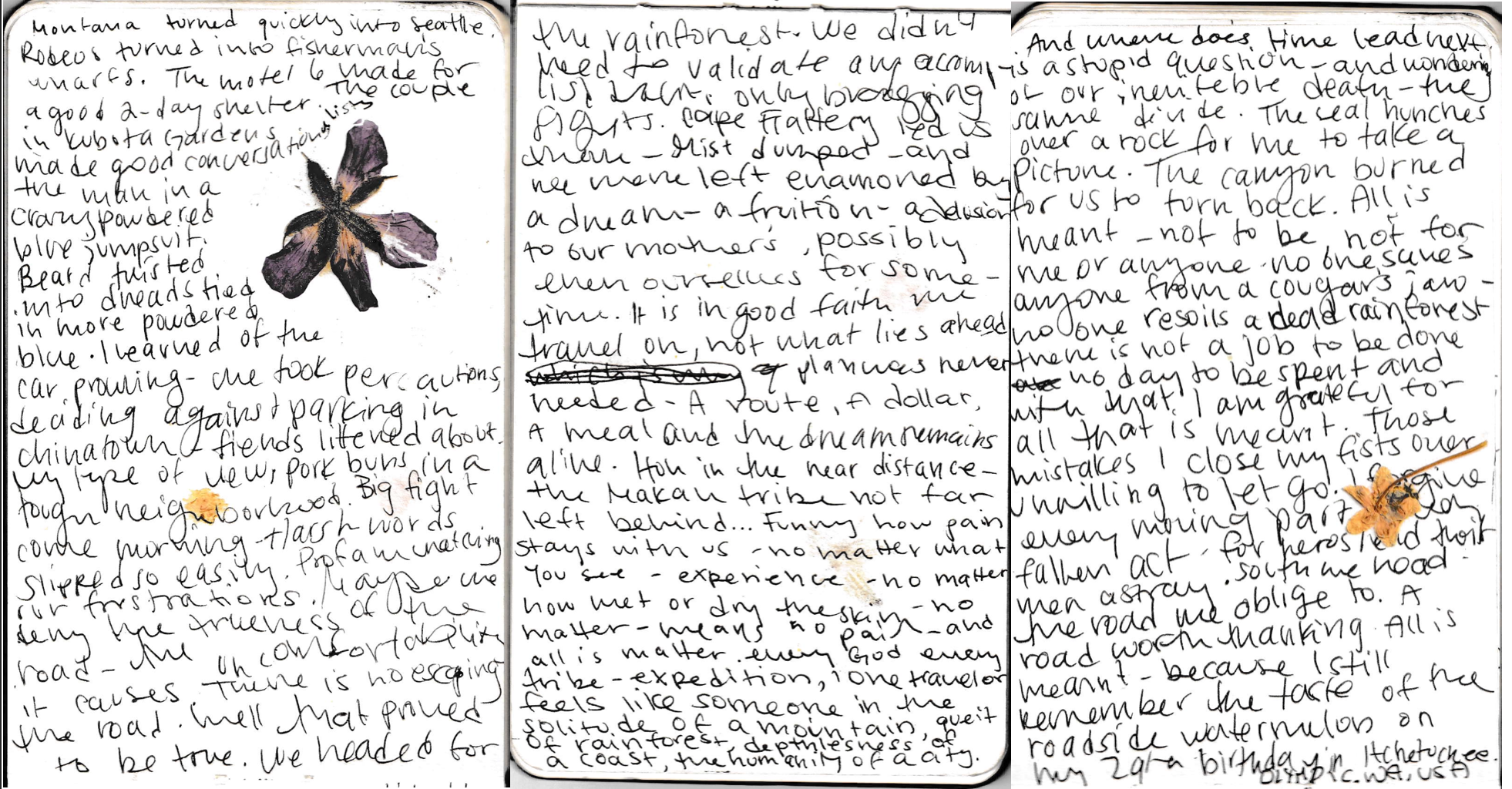
Much has transpired since my last entry. I jumped on my final flight destined for Seattle/Tacoma, leaving from Chi-town. I boarded, as one so often hopes to, took my paid-in-advance aisle seat, and immediately received a compliment from the woman in the middle seat of my chosen row—or rather the row fate chose for me, as I’ve come to gather. I almost left the same perfume she complimented behind; I almost renounced myself to wearing perfume altogether—thinking it was fucking up my endocrines, but nope, I’m just naturally a hormonal bitch. While change is good, it certainly doesn’t have to be enforced, because life is chock full of change whether you blip the matrix or not—just ask my savings account. Anywho, some personality traits and isms are good to stay; we cannot omit all ways of our being, and I won’t be trite and call them quirks, so you’re welcome.
The Sanskrit word “Shraddha,” in English, most closely translates to “faith,” but more pointedly, via The Gita, it is “a set of values, axioms, prejudices, and prepossessions that colors our perceptions, governs our thinking, dictates our responses, and shapes our lives.” I hate to admit that regret is very much a part of my Shraddha, but this story—to which I will get around to telling you, if my ADHD allows it—of meeting Breanna Morgan Martin and wearing the perfume scent coined “Extra Milk,” is not one of regret.
Breanna reminded me of Kpopp, my best friend back home, who stopped answering my calls a few years back due to what I believe to be drug-induced psychosis. Despite her absence in my life, I still consider her my best friend, and what that says about me is, well, a lot…. It wasn’t Kpopp’s crazy Breanna was reminiscent of; it was her frame, her way with strangers, her need to compliment others and make them laugh that connected the two. Breanna, or “B,” is full-native, born and bred in Fairbanks, Alaska and served in the Marine Corps for this Godforsaken country. She has two kids in North Carolina who she is forbidden to see due to a cruel stepmother. She has LJ though, short for Lorraina James—named after Lorraina James, to whom I’m forgetting what or where from. B told me that LJ is a baby so cute “you just want to punch her in the face,” while motioning a closed fist punch to the seat directly in front of her. I understood, because as a kid I always fantasized about death-gripping the cute teeny palm-sized ducklings that roamed my neighborhood.
B hadn’t the easiest of goings in life, especially generationally (which should be obvious to you without me using space on this page to explain). For your information, I type this stuff out from a tiny grayish-brown Moleskine, small enough that I’ve decided to reserve no space in it to teach the reader anti-first nation sentiment. That’s what books and the internet are for.
The Gita affirms the intergenerational dilemma we’ve reached when speaking of the unconscious mind—how it stores experiences, how we all have ancestral ties, some being more like pretty pink bows, and others like cracked-leather bondage. The historic and the current so blatantly add up, and I’m terrible at math.
B also shared that she had a brother who died after being pushed in the Yukon River. B tells me the river’s pull is like no other; “it just takes you”. He was twenty-one, and it was tragic to hear, but equally important for her to talk about it, materialize it, years later, with me, a stranger. She cried, and I caressed her arm with my hand. She also told me of her adoptive mother, who she watched wilt from stomach cancer. She was five years old at the time, and the last thing she said before she fell asleep in my Airbnb was, “I wish I had a mom.”
How she ended up at my Airbnb and how she came to be a best friend over the course of a four-hour flight is an easy thing to explain. Simply: both our hearts were open, both had been burned, both still longed for love. With those commonalities, we were never to be separate—one entity, one conscious. Long story short, B, during landing, realized her connecting flight to Fairbanks was the next day. She didn’t realize beforehand because she got to the airport initially by the skin of her teeth, due to life and the fleeting nature of time. “Fuck it, I’m sleeping in the terminal,” she let out with a shrug of pure defeat. My response was by no means usual of my character, nor my Shraddha. I have always had trust issues, thanks to the many junkies I surrounded myself with during my hay-day youth. Junkies are desperate, which translates to ruthless and apathetic. I grew up learning the way of stinginess; I went so far as to make it my protective earthwork. I had to be guarded then, and those characteristics sure made their way to my present, embedded unintentionally in my being. I turned to her and said, “You can stay with me!”.
You see, The Gita and scriptures alike are only useful in practice. They can be pleasure reads, sure, but selfless service is a main teaching, and I have a want to start practicing now, not later, as I have no say on the latter. In the case of meeting B, there was not a “no” in my mind. She is me, I am her, and we both needed a shower and bed all the same. I will continue to keep my heart ajar, for in doing so, a lasting friendship parted densely packed soil and planted new meaning. “See yourself in every person”, and know that you cannot gain without giving.
My Shraddha Had Regret
I Will One Day Attempt to Draw the Anatomical Heart
How hard is it? To be benevolent? Considerate? To practice humility? To know when you fuck up and to pay retribution to that person, thing, or community to which you fucked? Is being heartfelt easily employed, or is it something that needs mulling over to carry out?
To use the heart, one must know the heart. For one, there are four chambers of the organ—my lucky number. Maybe it was luck that didn’t kill me after all, because all those drugs, both fun and sad, that were meant to stop this pumper-thumper, this blood-burst being, never did. Let’s take a closer look via a swift Google search. One chamber receives oxygenated blood, the other deoxygenated, another pumps blood specifically to the lungs, and lastly, one pumps blood to the rest of the body. I’m too lazy to have chronologized these mechanisms, but I’m guessing they work simultaneously, in unison.
Save the four chambers and this—at least from me to you—useless knowledge, I’m more interested in the anatomical heart being hard to draw. Seldom do we attempt to sketch it when conveying love on paper; instead, we resort to other symbols. Even a teddy bear wrapped in a bow can symbolize something heartfelt: an “I’m sorry,” “my condolences,” “you’re loved in these trying times,” and so on. This notion brings me back to a memory that may also be useless.
One day, I taught the kids symbolism through the topic of love. They drew flowers, a box of chocolates, rings, necklaces, etc. Not one student drew a hug or a hand on a shoulder, which I thought was interesting. Overall, they materialized love. I gather now that love to them is gifts, but love, uncannily, to me at least, is the gift. I didn’t have this type of retrospective aha-moment at the time. Had I, I would’ve executed a split-second re-framing of mind for them to follow. For example, I may have asked the students to watch me while I drew love in action on the whiteboard. It could’ve been anything—from a young man helping an old woman safely cross the street, or a dog licking a tear from a widow’s eye. In my meticulous heart, I feel they would’ve liked this mini-lesson, and it actually wouldn’t have been a useless spiel, like some of my tangents so often are.
Whether they would’ve gained something from my little lesson, to mine and their detriment, there was no room for it that day, despite the District’s virtue-signaling and subsequent social-emotional learning initiatives. I’ve come to learn that the big wigs will say anything to pretend they care for the shaping of a new generation. Luckily for the kiddos, it’s easy to succeed your predecessors when ignorance is bliss and brain-rot is prevalent.
It’s funny. Our class periods are 45 minutes each—a sufficient amount of time, in the Department of Ed’s eyes, for us teachers to rally the kids to sit, let out a breath, take out a pencil, instruct on a topic, assess their comprehension of said topic, and quell their daily outbursts. Not to mention, it takes 10 minutes over the course of 10 one-minute intervals to say “just go” to the same students that need to go to the bathroom every day at the same time. I don’t think the students realize us teachers commiserate over their interruptive-isms on the reg. Maybe their bladders are indeed small, but it’s more likely that the weed and gossip in the bathroom is just too good to not feign a chronic bodily impairment for.
While I couldn’t intervene on their perspective of love, I didn’t see it as a negative. I’m here to merely guide their thinking and allow them to gain autonomy and agency over it and their organs, because it’s their heart and bladder for fuck’s sake. With that, the kids may always equate love to being material gain or object permanence, and it’s not my fault! It’s Kay Jewelers’ fault, the complex nature of the anatomical shape of the heart, the flowers they will or will not receive for prom, and so forth.
Maybe their view of love is skewed in my eyes because they’re not yet privy to bell hooks, despite my pleas, despite the fact that she is our class mascot—her picture dangling at the center of our classroom over the smart board they rarely give a glance to. I even started using crazy font, animated memes, and glittery auntie GIFs on my presentation slides to get their attention, but to little avail. Their impartiality to my lessons on hooks and her works, and my inability to get them to know and understand her, feels like a universal disservice to the future they will inevitably inhabit and run, but that’s just kids, and I don’t expect them to give a shit. I am actually deeply satisfied with and trauma-bonded to the ones who clap-back, draw dicks all over the worksheets I provide, and think I’m a slave-driver. Their irrefutable hate for sitting under carcinogenic fluorescent lights for 8-hours a day while being told to shut up and listen to a white-man’s text read-aloud is something I take pride in, because most us teachers loath it too. This system is built to to kill the spirit and we’re oftentimes compliant, complicit martyrs. I know this because teacher’s hallway exchanges are seldom warm greetings; they're salutes to soldiers going into battle.
If you got anything from this unfurling of my hopes and preoccupation with the anatomical heart, brava; and if you didn’t, just know that love is a noun, sure, but it being a verb takes us much further—to a distance worth enduring, a plight one would happily undergo, an end point that need not continue, because really, “we do not have to love, we choose to love.” (hooks).
Maranda arrived. We embraced hardily, because it’s been a while, and friendships like ours don’t come often. We have travelled to various places together: Paris, Heidelberg, Switzerland by accident, Amsterdam not by accident, L.A., Austin, Montreal, New Orleans, and now, Seattle. Soon we will closely border Canada to hike the beauteous North Cascades. Once there, I will write a poem, etch a sketch, strike a yoga pose, impress the birds, and, if I’m wishful, Maranda too. We’re at the Sun View Cafe on the second floor of the famous Pike Market. I’m finishing smoked salmon on a stick, and Maranda is beginning to spoon clam chowder. Finally, the weather is quintessential—gloomy. I’ve seen only sunny days since arriving earlier in the month. It’s October, by the way. Maranda claims the coffee lives up to Seattle’s reputation. It was exceptional, in other words. No surprise there. We will roam the lower levels of the market some more, talk and stroll the piers, find meaning for words we can’t remember—use Google for assistance. We will bitch, banter, and bask in the good too. It will all sound, look, and feel like our normal, and life will be forgiving, like wood as an art medium. “If you make a mistake, you just sand it down,” an artisan at Pike confessed. I like to think this entry is free of heavy ponderment. Just life in motion. Oftentimes I am critical of meaning—so critical I forget to just sketch the scene or emote the feeling. So here you have it: Maranda’s arrival, void of psycho-spiritual analysis.
Jot it, Sand it Down
Without reason
A tear wells. I mentally swallow it before it wets my cheek. I know it’s good to cry, but I feel I must write. There is no reason I’m sad—it just is, as most things are. In the interim of my reasonable, yet reasonless sadness, a memory glazed my mind. A convergence of uneventful moments that are strangely important.
The warmth
The drive past the palm tree–lined median entering Palatka. A scene that mirrored a 1930s Hollywood boulevard, as so much of underdeveloped Florida does. The stretch leading up to it—farmland, family-owned. The city limits—cracker houses littered with grandbaby bikes, rusted car parts, green overgrowth in the yard, and the occasional panting dog and tenant swatting flies on the porch.
Decisions stake chance
I remember being so attuned to my indecisiveness, how the space of possibility and vacancy of probability crippled me. He didn’t have that problem. I envied him for it, but was glad he had something to teach, and I, something to learn.
Pile burn
Where were we to go that day in Palatka? The thrifts were getting old and the one bookstore in town was always closed. So, we drove aimlessly, which bothered me—the not knowing where, the gas burning on by.
Without direction
He thought of it as “adventure.” “We’ll just drive until we find something.” His detachment to how the day would go wound up a blessing—made clear by the “Ravine Gardens State Park Ahead” sign to my right.
All the while, pleasing
He said “see,” and I smiled and praised him for his ability to see without foresight. I put on my sunglasses to hide how stoned I was then fixed my hair in the truck’s side mirror. As we walked down to the Ravines, I clutched him because I was high and strangers knew that.
Like nothing
We walked and talked very little. We passed a wedding rehearsal and the idea that we should get married here seemed nice—so much that I said it aloud. He agreed, but not with the fervor I had hoped for.
And yet
We walked. He videoed me. My hair fell long past the cuts of my wings, stuck to the damp of my neck. By this point, my want to look beautiful grew more important than comfort.
And so
We took refuge on a table bench near a small watering hole. Different-colored beads spread over the wooden surface; left behind by a child I assumed. I photographed the contrast—the bright plastic against dampened wood. He submerged his buzzed head under the water, as he so often did. I rolled up my jeans and removed my shoes and socks. There we were, together, feeling the same temperature of water—his head, my toes—yet I didn’t feel a closeness.
Not sure why
We continued on, coasting the edge of a jungle-like canopy. I didn’t know what to say and he had nothing to add. I felt contained, like water in a coconut.
A tear has yet to fall
Writing makes it known: there is no romance to this memory. Each word, a bright bead against dark grain.
Bright Beads